Review: Little Miss Perfect at Olney Theatre Vies for Virality
Joriah Kwamé knows how to craft a moment, but despite a strong cast and catchy songs, the musical needs more work to reach sustained perfection.
By D.R. Lewis
February 18, 2026
This review originally appeared in Washington City Paper.
In his lyrical retrospective, Finishing the Hat, legendary composer Stephen Sondheim set out his three rules of writing: less is more; God is in the details; and content dictates form. That’s not to say these are the only or definitive rules, of course, as evidenced by Joriah Kwamé’s Little Miss Perfect—a world premiere musical playing at Olney Theatre Center through March 8—which flips the last rule to construct a whole musical from a single YouTube viral hit. But whereas other social media musicals like Ratatouille: The Musical and The Unofficial Bridgerton Musical have found their stride sticking mostly to the platforms that bore them, translating “Little Miss Perfect” to Little Miss Perfect has proven a more difficult task, at times falling victim to its own desire for virality.
In the original song—a winner of the 2019 Write Out Loud contest—a buttoned-up Goody Two-shoes finds herself falling for a friend over the course of a tipsy sleepover, but buries her attraction by morning to maintain a facade of controlled perfection. Kwamé sticks largely to that outline in Little Miss Perfect, where the plans of overachiever Noelle (Leanne J. Antonio, excellent) to earn a full-ride scholarship to Howard University are foiled by a college admissions counselor (Brynn Williams) who deems her straight As insufficient. Noelle needs to take charge of her “Black girl magic,” the counselor says, encouraging her to demonstrate true leadership. Seeing an opportunity to do so in the upcoming student council election, Noelle enlists the help of neurodivergent freshman Eli (Donovan Fowler) and a Filipino exchange student, Malaya (Madelynn Elizabeth Ayen, magnetic), to run against a rich and racist popular girl, Gia (Mia Goodman). But when Noelle’s preacher mother (Kara-Tameika Watkins) invites Malaya to move in and love blossoms between the two young women, Noelle is forced to reckon with her aspirations, her sexuality, and her own conception of “perfection.”
The musical’s beating heart is palpable with an infectious joy from centering those who are often pushed to the edges of high school hallways and theatrical stages. That spirit is more than enough to send audiences home with a little more hope that underdogs do tend to win in the end, but is further bolstered by Kawmé’s witty, tuneful score and up-to-the-minute zingers. Just as “Little Miss Perfect” gained stand-alone recognition, it’s hard to imagine songs like “Black Girl Magic” and “Ordinary” achieving anything other than the status of audition room standards. And one particularly special earworm, “Malaya’s Words,” gushes with a lyrical romanticism that tugs at even the hardest of heartstrings. Kwamé proves in each of these what he did with “Little Miss Perfect”: He knows how to craft a moment.
Even so, you don’t have to look too closely to see all the big and little imperfections, contrivances, and conveniences in the space between such moments. Little Miss Perfect banks heavily on tropes rife in the most pervasive school stories from Mean Girls to High School Musical to Glee, but then cuts corners in the dramatic particulars that would otherwise set it apart. This tendency starts from the jump: Noelle’s introduction to the audience depicts her adoption at age 9, making an implicit promise that an excavation of belonging is in store. But this major life moment goes mostly overlooked until late in the second act, when it is instead used as fodder for an unearned anthem of acceptance from Noelle’s homophobic mother. Similarly, though Noelle and Malaya are meant to bond over the deaths of one of their parents, such a tremendous loss is mostly limited to the simple exchange of the information. And though Malaya is a foreign exchange student from the Philippines—an experience that would be intrinsic to the outsider status Kwamé is reaching for with the character—there are hardly any cues to indicate such beyond a rolling suitcase; even the decision to forego any semblance of an accent seems deliberate until Malaya imitates an aunt with a thick affect.
Director Zhailon Levingston and choreographer Chloe O. Davis try to smooth over some of those bumps through sheer force, smartly leveraging the ensemble in polished montage-style sequences. Levingston is especially effective at guiding the audience’s eye (in coordination with lighting designer Abigail Hoke–Brady) at events like a house party and a school activities fair. But some of the musical numbers are halting and do little to advance character or plot. They are then staged seemingly not for the benefit of theater audiences, but rather the viewers at home; they’d play perfectly as clips, but make little sense for the longer whole. This is most evident in a girl group-style number for the Howard Admissions Counselor (that is the character’s actual name, played by Williams again) that is brassy, flashy, and features a killer costume reveal (designs by Danielle Preston), and a sweet song for Eli and Leanne (Graciela Rey), one of Gia’s lackeys, at the local Steak ’n Shake. In the latter, the characters sit next to each other repeating the kind of frenetic hand choreography that is often replicated and riffed on in the infinite scroll, but they overshadow to the extent that the lyrics are washed out. These numbers don’t feel staged as much as packaged.
Still, the cast remains grounded on Lawrence E. Moten III’s handsome set, with Ayen and Antonio demonstrating “true leadership” in their honest, invested characterizations. They command attention with the deft backing of music director Patrick B. Phillips and the onstage band.
Social media may well have gotten its hooks into the American musical theater for good (three of the last 10 Tony Award for Best Musical recipients have dealt with digital lives to some degree). But if Reels and TikTok algorithms are fed by recycling songs, clips, and dances ad infinitium, Kwamé deserves credit for decidedly swiping left on adapting existing IP and instead creating something wholly original. Little Miss Perfect isn’t quite so yet, but the musical is on its way to finding its own reflection of perfection. I suspect, though, that it’s more likely to find it in the eyes of a young audience member than a glassy screen.
Little Miss Perfect, book, music, and lyrics by Joriah Kwamé, directed by Zhailon Levingston, choreography by Chloe O. Davis, and music direction by Patrick B. Phillips, runs through March 8 at Olney Theatre Center. olneytheatre.org. $42–$122.
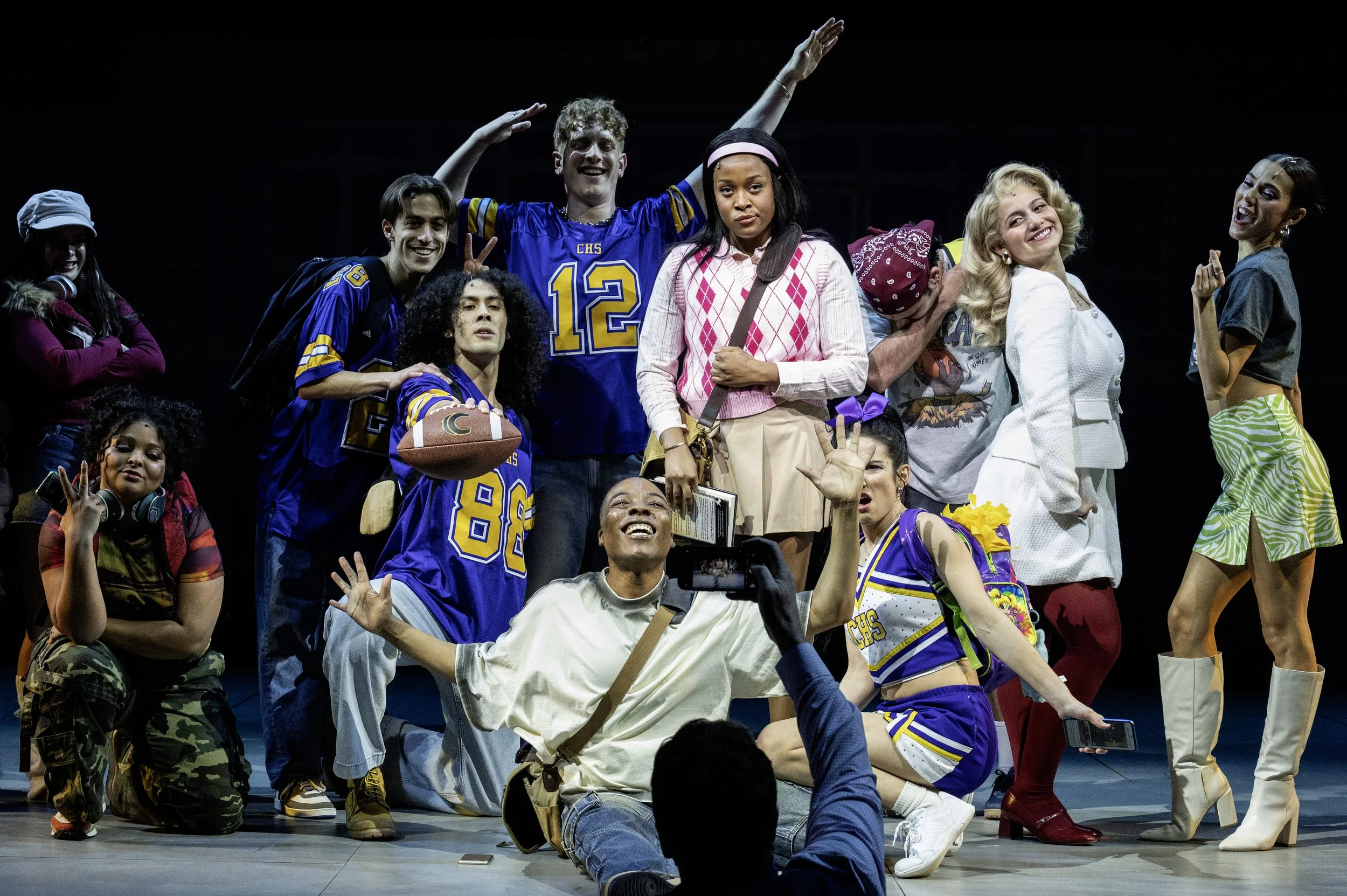
Leanne J. Antonio as Noelle Sanders (center) and the ensemble of the world premiere musical, "Little Miss Perfect" at Olney Theatre Center. Photo Credit: Teresa Castracane Photography