The musical from a creative team that includes Savion Glover and Scandal star Tony Goldwyn transcends the “revisal” label, has a sumptuous design, and needs a bit more fine tuning.
By D.R. Lewis
February 27, 2026
This review originally appeared in Washington City Paper.
The joy of musical standards lies in reinterpretation. In the case of “Bewitched, Bothered and Bewildered,” the centerpiece of the Richard Rodgers and Lorenz Hart musical Pal Joey based on John O’Hara’s 1940 novel of the same name, there are plenty to choose from: Ella Fitzgerald, Frank Sinatra, Linda Ronstadt, Sammy Davis Jr., and even a duet version with Rod Stewart and Cher. But in Chez Joey, a new musical inspired by Pal Joey playing through March 15 at Arena Stage, book writer Richard LaGravanese and choreographer and “orchestrologist” Savion Glover (co-directing with Scandal starTony Goldwyn) are taking reinterpretation to the next level by crafting a new story and set list from the old musical using songs from across the Rodgers and Hart catalog. The resulting play lives up to Pal Joey’s primary anthem, and is mostly bewitching, at times bothersome, and occasionally bewildering.
In the Bronzeville section of Chicago in 1940, nightclub owner Lucille Wallace (Angela Hall, enjoyingly tough) is struggling to pay the rent, though the house is always full. Joey Evans (Myles Frost typically, but Marcus John in the performance I saw), a slick and showy emcee, is eager to help, setting his sights on rich baroness Vera Simpson (Samantha Massell) and her seemingly endless resources. Alongside her gossip columnist friend Melvin Snyder (Kevin Cahoon), Vera has the money and social sway to reinvent Lucille’s as Chez Joey, the hottest new club for the city’s wealthy White elite. But when Vera’s investment comes at the cost of Joey’s community and budding love for singer Linda English (understudy Jordyn Taylor was on for Awa Sal Secka that same night), he has to evaluate how much he’s willing to lose to see his name in lights.
The differences between Pal Joey and Chez Joey are numerous enough that it transcends the “revisal” label affixed to Damn Yankees earlier this season. Most notably, Joey’s motivation for starting a club is no longer only about self-glorification, but a responsibility to preserving cultural legacy. And Linda’s ingenue status is grittier here as she becomes one of the club’s featured performers. Only a third of Chez Joey’s songs are lifted from the source musical—preserving the wonderful “Bewitched, Bothered and Bewildered” and “I Could Write a Book”—while similar classics like “My Funny Valentine” and “This Can’t Be Love,” plus deeper cuts from shows including The Boys From Syracuse and Babes in Arms make up the balance.
The songs work generally well in their new context (even if some of the arrangements feel yet unrealized) and you can see Glover’s creative synapses firing live onstage as he employs rhythmic stomping and other percussive movements to give the work a driving beat. With just a body and surface, he’s able to stir up a palpable tension that, when used consistently, hums continuously through scenes and songs even as the nightclub set (clubby and cozy with red velvet and dark wood accents by designer Derek McLane) remains stationary. When that underlying tension erupts into production numbers, like “The Lady Is a Tramp” and “Take Him” (another hanger-on from Pal Joey), the results are thrilling. And Glover’s knack for telling stories through steps is especially evident when Joey is dancing himself into exhaustion in “What Do I Care for a Dame?” and “Do It the Hard Way/Joey’s Way.” The choreography is not simply a highlight of the production, but the highlight.
The handsome staging, however, cannot totally obscure the challenges of the book underpinning it. In the scenes where the beat disappears, particularly between Joey and Vera, the pace halts, making one pine for the momentum that comes and goes in fits and starts. In some of these instances, underscoring helps, but the ultimate heavy-handedness of the text grinds against Glover’s more evocative, impressionistic choreography. LaGravanese is in a tough position of negotiating predefined characters with the memory of a musical they’re no longer in and a halfway-jukebox score. On a high level, the concept is very compelling: Black performers in the early 1940s are trying to hang on to a piece of culture that is at risk of appropriation by a wealthy White woman who is eager to capitalize on it. But on the line level, LaGravanese defaults to shortcuts in characterization, indulging cliches that diminish the opportunity to say something revelatory. Specificity is confused for literalness here, and expository tidbits—a dream house, a lost baby, affairs with chorus boys, an absent husband—fly into the audience like trumpet blares, but disappear as quickly as they came to reveal the platitudes behind them, which they often seem intended to tee up.
More puzzling is that Arena Stage has produced Chez Joey in the proscenium Kreeger Theater rather than the in-the-round Fichandler Stage, which would so naturally lend itself to the nightclub setting. Glover and Goldwyn flirt with audience immersion as characters chip away at the fourth wall, but one walks away with the feeling that Chez Joey is still very much a musical in development, trying to determine—like its main character—who and what it wants to be.
There’s plenty going for it still, including a sumptuous production design led by McLane. Emilio Sosa’s gorgeous costumes refreshingly flatter a variety of bodies and beg for more investment. Lighting designer Adam Honoré captures the hazy essence of a club without needing the smoke, and excitingly desaturates otherwise warm hues when Joey sees his vision start to slip away. Wig, hair, and makeup designer J. Jared Janas is most effective at conveying the essence of the period, and sound designer Dan Moses Schreier does his best to balance the voices of the performers with the thundering band behind them (Victor Gould serves as music supervisor).
In place of the principals as Linda and Joey, understudies Taylor and John seemed exceptionally well rehearsed and seamlessly offered first-rate performances built on natural chemistry and an easy vocal blend across a trio of duets. John’s a particularly skilled dancer, and Taylor’s control over her rich voice is enviable. As the steward of two of Pal Joey’s best songs, Massell manages an expert delivery with intuitive phrasing, and does good work bringing depth to a tricky character. And though the ensemble is uniformly strong, Kalen Robinson is raucously delightful as Pearl.
I doubt this is the last we’ll see of Chez Joey, and with more work and exploration—and a homing in on its evident strengths—this reinterpretation may achieve “standard” status yet.
Chez Joey, with music by Richard Rodgers, lyrics by Lorenz Hart, a new book by Richard LaGravanese inspired by John O’Hara’s novel (Pal Joey), choreographed by Savion Glover, and co-directed by Tony Goldwyn and Glover, now extended through March 22 at Arena Stage. arenastage.org. $83–$143.
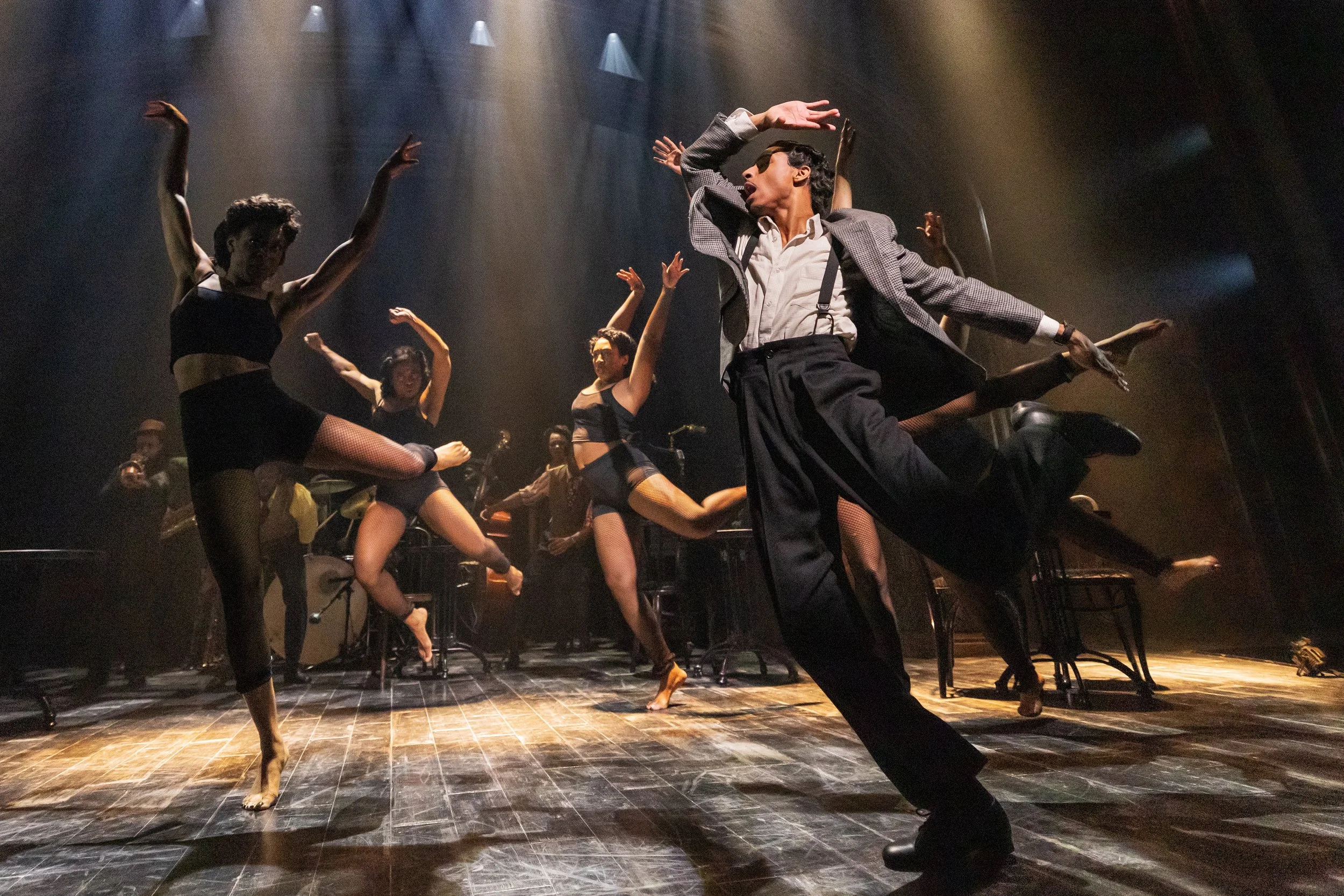
Myles Frost and the company of Chez Joey at Arena Stage through March 15. Photo credit: Matthew Murphy.