Review: The Bard Gets Bawdy—and Queer—for World Pride in Folger’s ‘Twelfth Night’
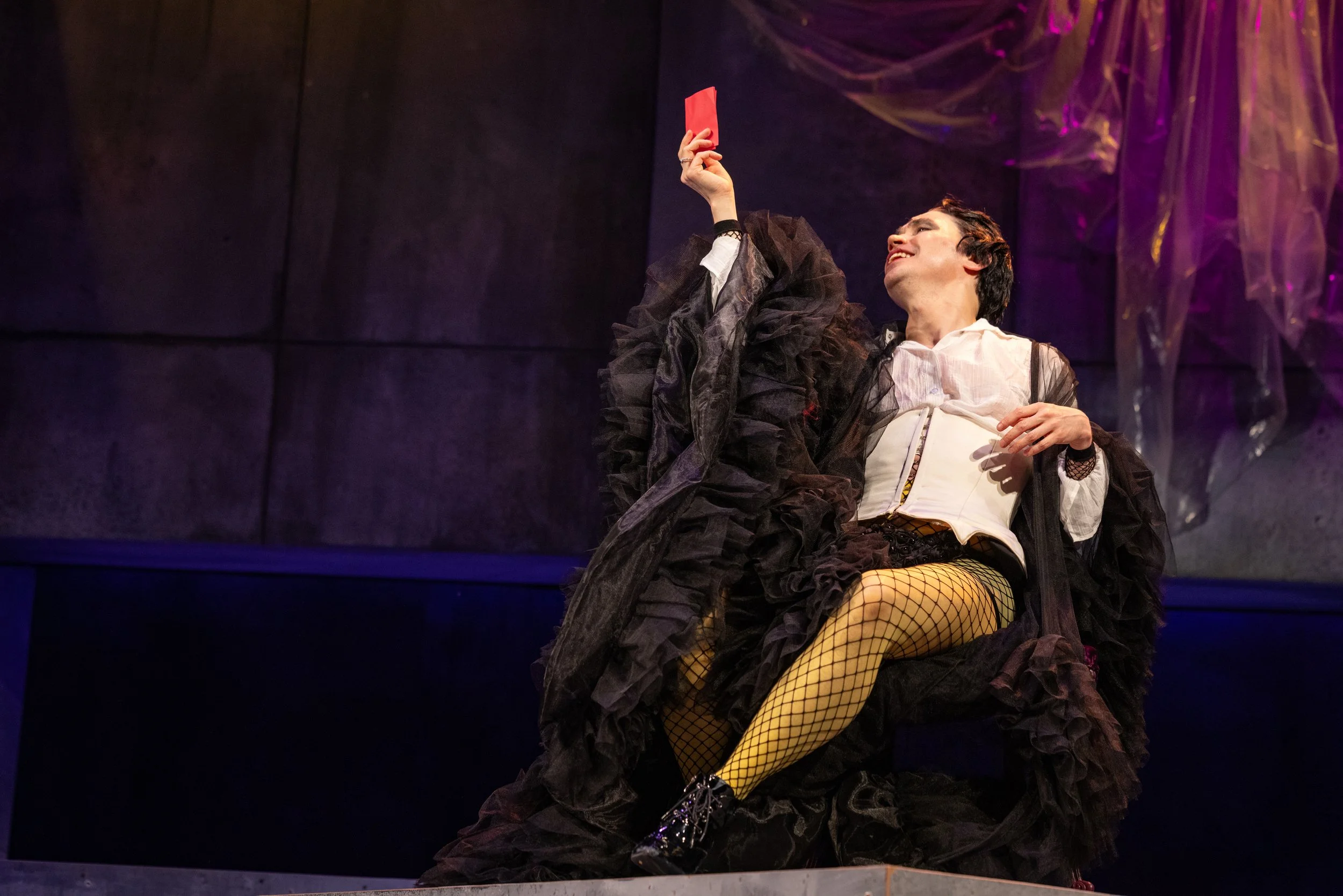
When one thinks of William Shakespeare and fruit, perhaps the first thing that comes to mind is the pomegranate tree from which the nightingale sings to Juliet, a wishful mistake for the morning lark that brings an end to the young heterosexuals’ first brush with forbidden love. That might not be the case for much longer, though, at least not for Folger Theatre audiences who take in director Mei Ann Teo’s bawdy new production of Twelfth Night, which plays through June 22 and touts an unusually large bag from Bite the Fruit, the longtime Dupont Circle purveyor of “provocative apparel and adult novelty.” But unlike that other play, there isn’t much that’s forbidden (or particularly hetero, come to think of it) in Teo’s lively staging.

Review: Humanity and AI face off in ‘Your Name Means Dream’ at Theater J
“What makes ‘beautiful’ beautiful?” is a question that could launch any number of unending linguistic or philosophical discussions (and probably has). Consider its connection with artistic inspiration, or perhaps divine grace and the ability to distinguish between good and evil. It offers plenty of threads on which to tug, but in Your Name Means Dream, playing at Theater J through April 6 in a co-production with TheaterWorks Hartford, playwright José Rivera instead poses the question as a bookend in his evaluation of humanity’s relationship with artificial intelligence, and the experiences of the soul that differentiate us from it.
Review: Edith Wharton’s Gilded Age Comes Alive in Arena Stage’s ‘The Age of Innocence’
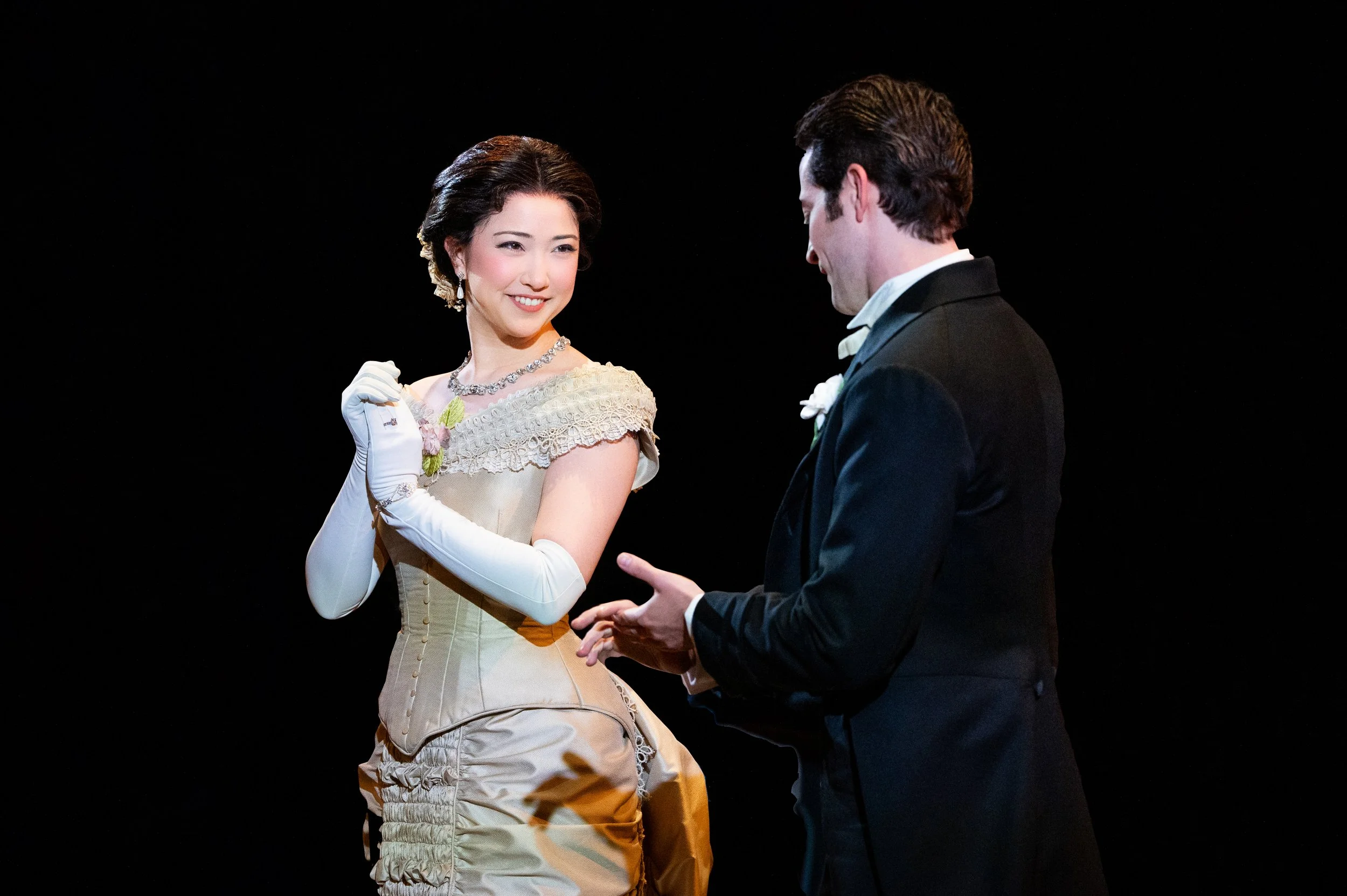
In a New York Times essay last fall, Shakespeare Theatre Company artistic producer Drew Lichtenberg quoted an unnamed theater administrator regarding the challenging post-pandemic state of the arts when he said, “Agatha Christie is single-handedly saving the American regional theatre.” As the recovery continues, and the future of federal arts funding is called into question, it’s no wonder that regional theaters are calling on properties with strong name recognition and a deep well of public goodwill to bring audiences through their doors. Even the Broadway season abounds with adaptations, from Oscar Wilde’s The Picture of Dorian Gray to television shows Stranger Things and Smash, and films Death Becomes Her and Good Night, and Good Luck. Arena Stage, among the most storied and historic regional theaters in the country, is no exception to the trend. Artistic director Hana S. Sharif, who staged Christie’s Death on the Nile late last year, has brought Edith Wharton’s beloved novel, The Age of Innocence, to the Fichandler Stage, in a smart new adaptation by Karen Zacarías running through March 30.

Review: Urine Good Hands With Sarah Silverman’s ‘The Bedwetter’
Reclined in her bed, which she rarely leaves, clinically depressed mother Beth Ann offers, “It’s important to see someone at the start of their career or you don’t get to see how they grow.” Ostensibly, we know she’s referring to Irene Cara and her star-making role in the 1980 film Fame. But we understand she’s really talking about the 10-year-old potty-mouthed, bed-wetting, soon-to-be-famous comedian lying next to her, Sarah Silverman. And what a joy it is to see this tiny Silverman (Aria Kane), sliding into adolescence in a baseball tee and rainbow suspenders, without our privileged knowledge of the extraordinary career that lies ahead of her. Adapted from her memoir of the same name, Silverman, with co-book writer Joshua Harmon and composers and lyricists David Yazbek and Adam Schlesinger (of Fountains of Wayne fame, who passed in 2020), have created a hilarious new-ish musical that takes the piss out of growing up depressed. Following a 2022 run at New York’s Atlantic Theater Company, this re-worked The Bedwetter is enjoying its regional premiere at Arena Stage through March 16.

Review: ‘Constellations’ at Constellation Theatre looks for love among the stars
“Do you know why it’s impossible to lick the tips of your elbows?” You’d never guess that such an innocent question could kick off a dizzying 80-minute metaphysical probe into the precarious miracle of human love. But in Nick Payne’s Constellations, playing at Source Theatre in a production by Constellation Theatre Company, lovers Roland and Marianne are a cosmic case study in just that, weaving their love story through a repetitive series of self-variations that tracks the course of a relationship through topics as wide-ranging as quantum mechanics, the utilitarian social structures of beehives, and free will.
Review: ‘Hand to God’ at Keegan Theatre flips the bird at religion and repression
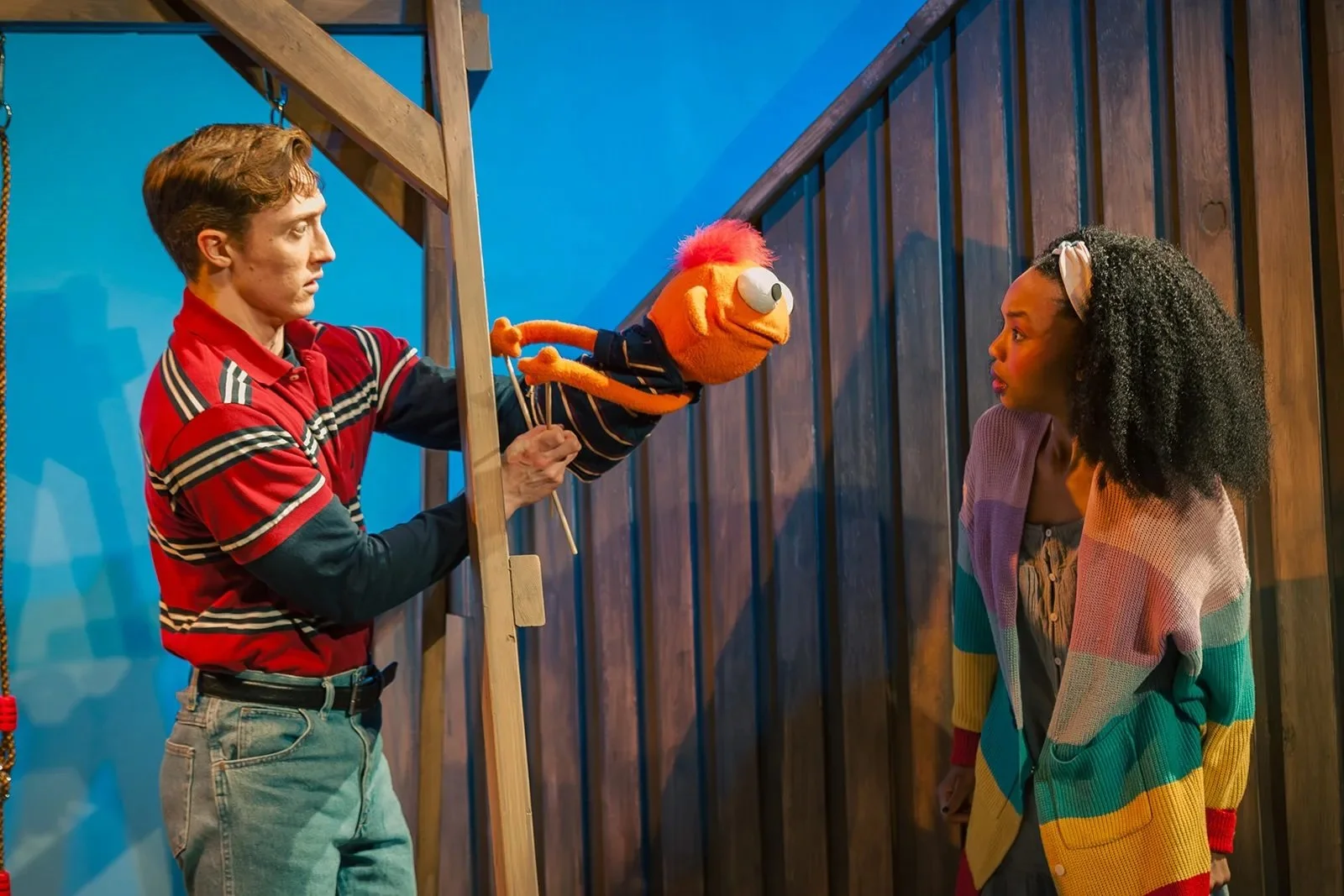
There’s something a little slithery about the way Drew Sharpe maneuvers his sleeve-and-stick orange puppet Tyrone in the first moments of Hand to God at Keegan Theatre, even before it opens its toothless mouth. It looks innocent enough, with side-facing eyes and tuft of red hair. But as Sharpe’s hand spreads and a vulgar diatribe on the origins of the society and evil comes spewing out, one can’t help but look instead at the snakelike arm that’s enlivening the possessed puppet. You half expect, in the midst of this slick sleight of hand, for Tyrone to offer you an irresistible apple.

Review: The hits parade in exhilarating ‘& Juliet’ on tour at Kennedy Center
William Shakespeare’s Romeo and Juliet has long been fertile ground for reinvention: from adaptations including West Side Story and Gnomeo & Juliet to modernized productions like Broadway’s current Sam Gold–Jack Antonoff collaboration and Folger Theater’s extrapolitical take earlier this season. But what if those star-crossed lovers hadn’t died? And what if Juliet was given the chance to begin anew as a young woman free of her warring family? And, as an added bonus, what if the soundtrack of her life happened to be curated by one of the most successful pop producers of all time Those are the central questions of & Juliet, a jukebox musical featuring more than two dozen of music producer Max Martin’s greatest hits and playing at Kennedy Center through January 5.

Review: Kate Eastwood Norris and Holly Twyford are not to be missed in ‘Summer, 1976’
“I hate the name Holly.” Delivered in deadpan by Kate Eastwood Norris in the opening moments of David Auburn’s Summer, 1976, the otherwise innocuous line elicits a disproportionately large laugh, like an inside joke. And it is, in a way, as prolific Washington actress Holly Twyford sits just a few feet away, utterly unfazed by the line or the laugh, and remains dutifully in character. So it goes for the duration of the play’s 90-minute run in Studio’s Milton Theatre, where the pervading sense is that one is settled among friends.