Review: Studio Theatre’s The Heart Sellers Mines the Middle of Here and There
Lloyd Suh’s tender play tells a different immigration story than what we’re seeing play out today, but it offers plenty of truths about what it means to be human.
By D.R. Lewis
October 6, 2025
This review originally appeared in Washington City Paper.
There isn’t much talk about religion in Lloyd Suh’s The Heart Sellers—playing at Studio Theatre through Nov. 2—but there is faith in spades: that a frozen turkey will still cook through, that one job may soon turn into a better one, that a woman and her husband will someday have enough money to buy tickets to Disneyland, and that a new life built here will be happier than the one left behind. It is Thanksgiving in 1973, after all, and though Watergate rages on, the American dream is (presumably) alive and well.
But these dreamers are not American, at least not yet. Luna (Francesca Fernandez), a recent immigrant from the Philippines, is spending the day alone while her husband works; since he’s an immigrant too, his supervisors assume missing the holiday wouldn’t mean much to him, or to her. On a distracting excursion to the grocery store, she encounters a Korean immigrant named Jane (Jeena Yi)—they are the only two out and about—whose doctor husband is also on the clock. Luna invites Jane up to tiny apartment done over in the same mustard yellow and pea green they saw in the store (scenic designer Marcelo Martínez García is responsible for the beautiful set) to keep each other company, drink wine, and make sense of their new lives on the second most American holiday (behind Independence Day, of course). The turkey never does cook, and aside from an occasional bathroom break or topping-up, not much else happens either, but for 90 gripping minutes, it’s impossible to look away from the pair, who admit how heavy their leap of faith feels, even as they extol the virtues of Soul Train, Kmart, and Ritz Crackers, and give thanks for finding a new friend.
But just as the first Thanksgiving is so often prone to mythologizing, so is the American dream, and Luna and Jane cautiously admit to each other that things even as minute as vegetables and dust are different in the U.S., but that the feeling of being here is not so different from the scars of war and corrupt regimes left behind. (Richard Nixon pops in and out on the radio denying his involvement in the Watergate affair, with sound design by Liam Bellman-Sharpe.) Their sense of otherness is exacerbated by their spouses’ own impositions, as Jane’s husband cautions her against becoming too friendly with other non-Americans in his effort to assimilate more easily.
Luna feels most acutely caught in the middle of here and there, especially the sacrifice of proximity to culture and family that often comes with immigration, and Fernandez mines that feeling to great effect. Luna’s bubbliness at the outset is tinged with an anxiety that we quickly realize is not simply borne of wanting to impress Jane, but rather from desperately trying to hold on tightly to someone who may understand her. So much of what Fernandez conveys as Luna is not in the text, though Suh gives her plenty to work with. Fernandez masterfully fills silence with nervous laughter, averts her gaze when she isn’t being entirely forthcoming, and practically vibrates in trying to suppress her fear. When Suh finally allows Luna to voice that fear, in a sequence that explains the title of the play (a riff on the Hart-Celler Act, which enabled Luna, Jane, and their husbands to immigrate, and which formed the basis of modern immigration policy), Fernandez’s performance is especially gut-wrenching.
In contrast, Jane takes the challenges of acclimation mostly in stride. Yi plays her with a dynamic bluntness that can also be warm and reassuring to Luna; it’s easy to see why they are drawn to each other. Yi projects confidence in her unflappable characterization of Jane, who in turn projects confidence to Luna, even when she stands suspiciously in the doorway. Her performance is a grounding force for Fernandez’s performance and the production as a whole, and together they manage a chemistry that is seldom achieved, but reminiscent of that between Kate Eastwood Norris and Holly Twyford in last season’s Summer 1976 on this same stage.
Director Danilo Gambini leverages the intimacy of Studio’s Milton Theatre to great effect. As Jane and Luna maneuver around each other at the outset, you can sense their isolation. But when they eventually come to sit closely to each other on the couch, and finally put on comfortable “home clothes,” you can sense their hold on their little piece of this country grows stronger. In addition to Martínez García and Bellman-Sharpe, Gambini’s design team does great, unflashy work in bringing that piece of the world to being. Lighting designer Minjoo Kim employs a fade at a glacial pace that captures the contemplative nature of a late fall day. And Helen Q. Huang’s costume contributions draw a line between American fabrics and styles of the early 1970s with the comforting cuts and colors of Luna’s home country.
Suh’s play—with all its tenderness and yearning for human connection—arrives in D.C. at the end of a summer marked by far more brutal images of immigration struggles, some of which played out only a few blocks from Studio Theatre. And beyond more than 50 years separating now and then, Luna and Jane’s experience as wives of highly skilled workers inevitably varies from those who are undocumented. The Heart Sellers is not a story of coming or staying, but one of settling, and some may struggle to square this story with those playing out around us right now.
But there are still truths at the core of The Heart Sellers that are worthy of reminder: that running away from somewhere and running to somewhere—like hurt and hope, or sadness and joy, or fear and faith—are not mutually exclusive.
The Heart Sellers, written by Lloyd Suh and directed by Danilo Gambini, will run through Nov. 2 at Studio Theatre. studiotheatre.org. $42–$117.
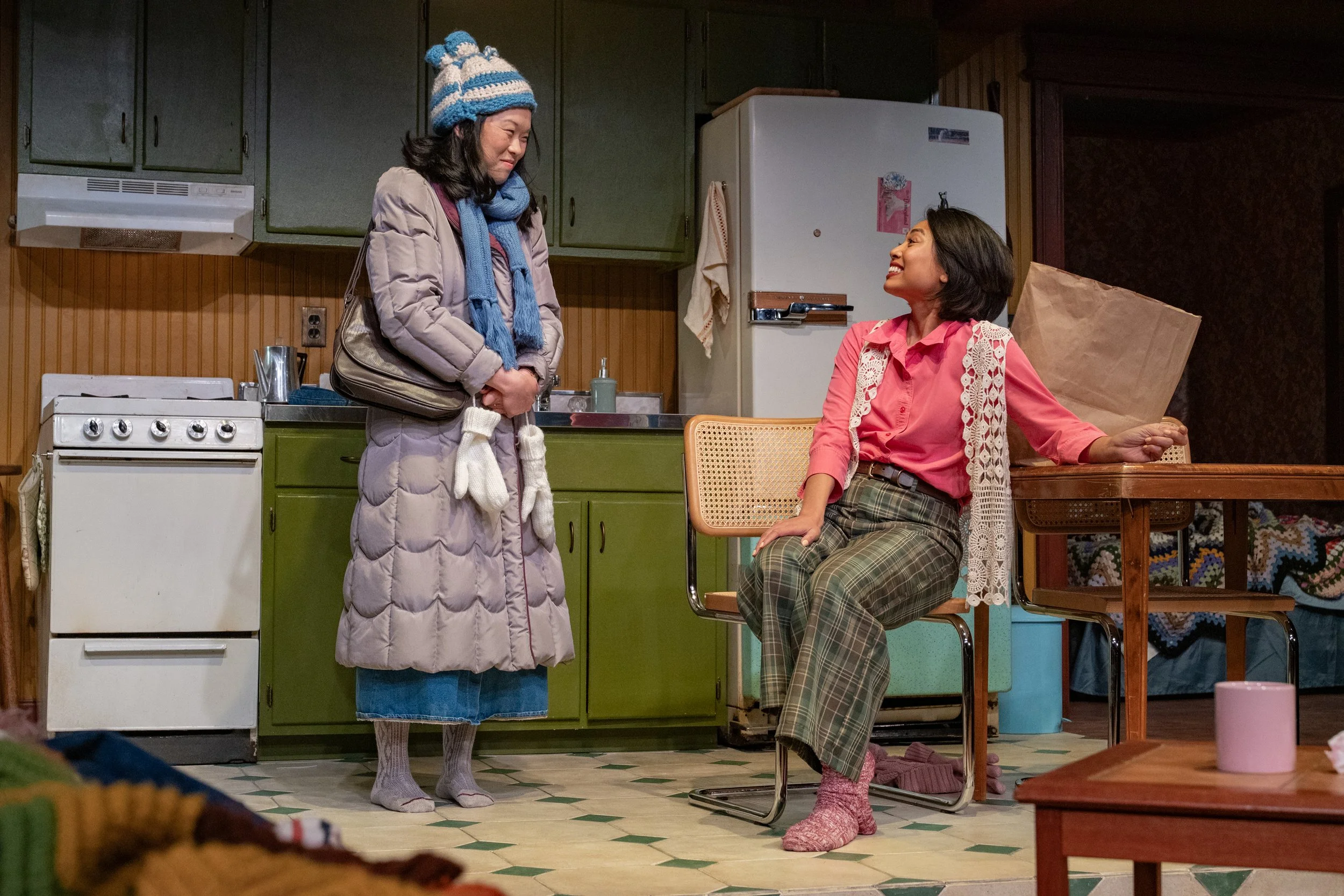
Jeena Yi and Francesca Fernandez in Lloyd Suh’s The Heart Sellers. Photo credit: DJ Corey Photography