Review: Damn Yankees at Arena Stage Tests a New Swing
Can you teach an old musical new tricks? This handsome revisal, directed by Sergio Trujillo, adds new layers and raises plenty of questions.
By D.R. Lewis
September 24, 2025
This review originally appeared in Washington City Paper.
If you see a crowd of Baltimore Orioles fans streaming out of the Waterfront Metro station, rest assured they did not make a navigational error en route to Nationals Parks. They’re probably heading to Arena Stage’s home-run production of Damn Yankees, the cherished albeit dusty musical by composing team Richard Adler and Jerry Ross and book writers George Abbott and Douglass Wallop that has long been a workhorse for high school productions and community theaters. But co-adaptors Will Power and Doug Wright have brushed off the plate with the assistance of director and choreographer Sergio Trujillo for what amounts to spring training—or at least a fall tryout—of a production that runs through Nov. 9 and is openly eyeing a Broadway transfer next year.
In this Damn Yankees, we find middle-aged couch potato Joe Boyd (Quentin Earl Darrington) leaning forward in his armchair agonizing over yet another losing season for his beloved Orioles. His wife, Meg (Bryonha Marie, an extraordinary talent delivering a standout performance), a devoted schoolteacher, laments that for “Six Months Out of Every Year” she loses Joe to the game he loves. In fact, his passion for it runs so deep he’d sell his soul for a pennant, an offer seized upon by a mysterious man named Applegate (Rob McClure, perfectly cast) who transforms Boyd into star athlete Joe Hardy (Jordan Donica). Joe was savvy enough to demand an exit clause, however, and as he carries the team toward victory, Applegate intervenes with scandals and seductions by minion Lola (Ana Villafañe, terrific) to ensure Joe’s soul will soon be his. Joe must grapple with the joy of winning, the demands of newfound fame, and the prospect of losing the comfortable life he built with Meg as he comes to terms with what his love of baseball really entails.
Trujillo has called this production a “revisal,” rather than a revival, and the adapters have focused primarily on the book while dutifully leaving the highly underrated score intact (with some sensible lyric changes by Lynn Ahrens of Ragtime and more). Aside from pushing the timeline forward 45 years to 2000 and swapping in the Orioles for the then-defunct Washington Senators—a choice that avoids an anachronism but steals a little soul from this town’s devoted Nats fans—perhaps the most consequential change is the introduction of a new motivation for Joe’s ultimate deal with the devil: The desire to make his father, a minor league baseball player who was kept out of the major leagues because he was Black, proud of him. The change works well dramatically, but inadvertently lays bare the limitations of retrofitting classic musicals with new elements and motivations. Had this been an original musical, Joe’s relationship with his father would have been fodder for a pivotal song in either act. But this is a revival, and while Ahrens seeds the paternal motif in some of the existing songs, it fizzles in the absence of a dedicated number. The creative team seems to sense this and attempts to see the story through with a sequence that incorporates “The Star-Spangled Banner.” It is beautifully sung by Donica, who lends a soulful introspectiveness throughout the entire production, but ultimately doesn’t live up to its promise.
Still, kudos must go to Trujillo, Wright, and Power for their loving reconciliation of past and present, and their adeptness at balancing preciousness with pragmatism. In addition to the fatherly component, they impart a wide range of subtle and more obvious maneuvers to signal that this is not your grandfather’s Damn Yankees. References to baseball icons like Sammy Sosa and Derek Jeter abound, as do touchstones like Axe body spray. In the opening number, Meg is joined in her lamentation by stand-ins for families who transcend the bounds of the stereotypical 1955 American home; one couple has the husband cradling the baby while his wife is glued to the game, and another consists of two gay men.
Additionally, this Damn Yankees sounds like it did in 1955 (music supervisor Greg Anthony Rassen’s arrangements are lovely), which makes for a fun exercise in melding modern sensibilities with that classic Broadway sound (consider Schmigadoon!’s success). Surprisingly tender songs like “Near To You” and “Goodbye, Old Girl” are a treat to revisit, and soar in the hands of Marie, Donica, and Darrington. As a theater veteran with more than a dozen Broadway credits under his belt, Trujillo understands what makes for a great dance number and swings big. He blends classic dance with the precise athletic movements you’d find on the diamond and the results are beautiful and thrilling (particularly in “Shoeless Joe From Hannibal, Mo.’”). The ensemble is more than up to the task as Trujillo makes great use of an otherwise challenging in-the-round configuration that is bordered by squat screens (the excellent projection and set designs are by Peter Nigrini and Robert Brill, respectively) that at once evoke home televisions, decked-out sports bars, and jumbotrons. Lighting designer Philip S. Rosenberg further conjures the stadium feel by incorporating the iconic overhead flood light waffles that attract midges and mayflies on warm summer nights. And if costume designer Linda Cho was not entirely faithful in recreating the Orioles’ 2000 uniforms—which are somehow as pretty as Lola’s sparkling leotards—she could’ve fooled me.
But how far can a handsome production—and Trujillo’s production is very handsome—and smart textual adjustments go with an otherwise stiff foundational framework? The question catches up to Damn Yankees in the second act, which is a veritable parade of dance numbers and character songs that are indicative of mid-century musicals, but do little to advance the scant story that remains to be told. Damn Yankees may be best remembered as the show that launched the longtime professional and personal connection of actor Gwen Verdon and choreographer Bob Fosse; even now it’s obvious where the creators were writing to showcase Verdon’s strengths. But Power, Wright, and Trujillo are clearly trying to say something more profound through Joe than Abbott and Wallop were. Damn Yankees should be more than the sum of its parts, but just when the game’s getting good, numbers like “Who’s Got the Pain?” and “The Game” intercede like commercial breaks.
I wonder, too, about the distance between sport and theater audiences, which was probably not so great in 1955 as it is today. There was a time when Broadway selections wound up on the radio, and “Whatever Lola Wants” was recorded by some of the biggest stars of that era. In some ways, it seems the creators are reaching for something closer to Richard Greenberg’s Pulitzer Prize-winning 2002 drama, Take Me Out—in which a gay MLB pitcher’s coming out raises questions of masculinity and homophobia in and outside the locker room—than the bouncy musical they’re working to “revise.” At the least, it shows how comparatively naive the musical was then, and maybe now. As the Orioles sing of their troubled record and hopes for the future, they decide all they need is their love of the game. But Jeter and Sosa (and Axe) aside, this Damn Yankees largely overlooks how dramatically the game, and the business around it, have transformed in the years since the musical premiered: the rise of fantasy leagues, the legalization of sports betting, and the proliferation of adjacent industries that have sprung up around professional sports. In each case, it’s about wanting a piece of the pie, feeling like a part of something extraordinary, being a part of the winning team. Joe wanted a version of that in 1955, but the stakes feel higher now, and in 2000.
he Damn Yankees revisal raises the question: Do we play for the win or the love of the game? It’s a tricky one that leads to another: Do we let old musicals sit like sandlots, or do we water the grass, paint new lines, and aim for the fences with our very best swing? You might hit a homer, like Power, Wright, and Trujillo, or lose in extra innings. But one thing’s clear: If you’re gonna step up to the plate, it helps to have heart.
Damn Yankees, newly adapted by Will Power and Doug Wright and directed by Sergio Trujillo, runs through Nov. 9 at Arena Stage. arenastage.org. $49–$103.
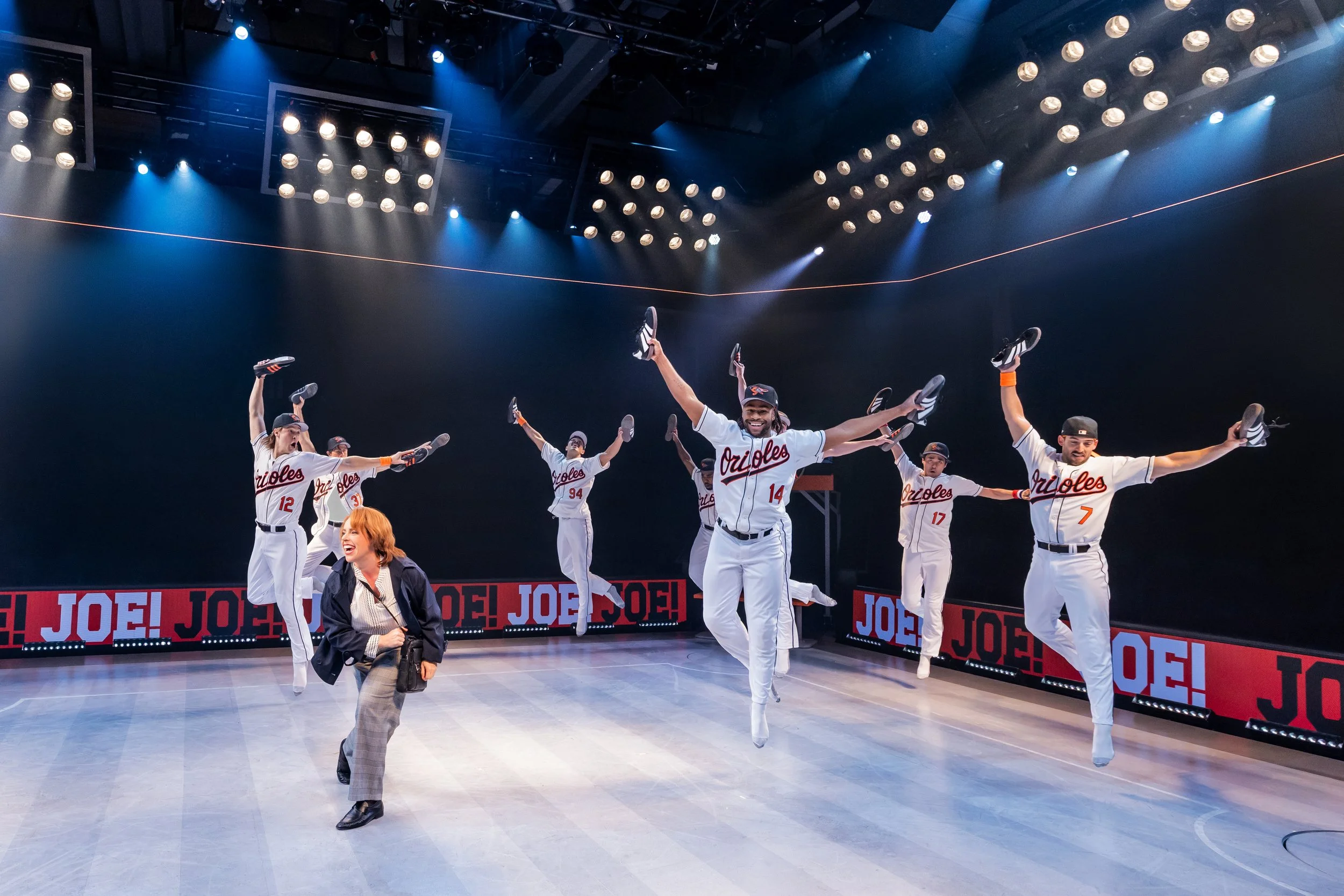
Alysha Umphress (Gloria Thorpe) and the company of Damn Yankees at Arena Stage through Nov. 9. Credit: Matthew Murphy and Evan Zimmerman