Review: Mosaic’s A Case for the Existence of God Offers a Muddled Argument
Despite good direction, solid performances, and a well-designed production, Samuel D. Hunter’s play is too busy focusing on the divide that it misses the connection.
By D.R. Lewis
November 20, 2025
This review originally appeared in Washington City Paper.
There’s unspeakable devastation in actor Lee Osorio’s eyes when his character, Ryan, confronts the prospect that he may not get the mortgage he needs to build his dream home in Samuel D. Hunter’s A Case for the Existence of God. (Mosaic Theater Company’s production plays at the Atlas Performing Arts Center through Dec. 14.) He suggests to his mortgage broker, Keith (Jaysen Wright), that he might call the bank himself. He’s a good guy, after all, and if he can just explain his plans and dreams to them, they’ll approve the loan. Right? “They don’t care about who you are as a person,” Keith says, dismissing Ryan’s naivete. “It’s just numbers to them.”
The dashing of dreams and the loneliness of wandering through life are hallmarks of Hunter’s typically moving plays, which often take place in his native Idaho; landlocked and ranking 44th among the 50 states in population density, it’s fertile ground for such a sense of remoteness. Bouncing between Boise and the backcountry, Hunter’s deep backlist has mined complex relationships between men, the uphill battle to secure and hold fast to economic security, and coming to terms with social pariah status (gayness is a recurring souce for this, though he’s also employed religiosity and obesity, as in the case of The Whale, which Darren Aronofsky made into a 2022 film with Brendan Fraser). But in A Case for the Existence of God, Hunter attempts to distill these themes through stark contrasts in just two characters: gay and straight, prosperous and poor, Black and White. Really, the only things the men have in common are their fatherhood (albeit attained through very different means) and their isolation.
Ryan is the recently divorced father of 15-month-old Crystal. His dreams of owning an ancestral plot of land that developers are circling is impeded by his low credit score and working-class income (a timely dramatic hitch, as a historic housing market is struggling to find buyers who can afford homes). Ryan turns to Keith, a Black queer mortgage broker who is fostering a baby, Willa, who he hopes to adopt as quickly as possible. Former classmates (though only Keith remembers Ryan), their professional relationship quickly turns friendly as they recognize in the other the kind of suffering they are feeling themself. But when Ryan’s desperation to make his dream come true threatens Keith’s career, they both have to grapple with the limits of their dreams.
Director Danilo Gambini, who directed a separate two-hander concerned with navigating place and identity in Lloyd Suh’s The Heart Sellers earlier this season at Studio, seizes on the opportunity to demonstrate how hemmed in the characters are by their circumstances. In a boxy office where window blinds are pulled down (set design by Nadir Bey), the men’s feeling of claustrophobia is clear. Even when they’re ostensibly at Keith’s house, demolishing a bottle of bourbon and baring their souls to each other (Willa is heard occasionally through a baby monitor), they are still sitting on office chairs a foot away from the desk, always under the shadow of adoption and home-buying bureaucracy. Sound designer Sarah O’Halloran and lighting designer Colin K. Bills tag-team transitions with loud whooshes and clicks, and flashes of bright colors, to signal advancements in time. O’Halloran’s ambient playground soundscape is especially effective at conjuring an imagined world beyond the office. And when Osorio and Wright finally step out of the box near the end of the play, Bills unveils a massive ring of neutral light that brings the action literally full circle.
Gambini’s savvy staging makes up for some of the dramaturgical stretches Hunter tasks his actors and audience with excusing. For instance, Ryan’s inflexible tether to Twin Falls is clear; his father’s death, his mother’s addiction, and an all-around challenging childhood and adolescence did little to set him up for success, and he didn’t have the means to leave. But Keith did have a chance to leave, studying early music in college (a plot point on which O’Halloran rightfully capitalizes) before transitioning to a career that he could perform anywhere, and which allows him to maintain the comfortable life his lawyer father was able to offer him as a young man. Why he has chosen to stay somewhere that seems to have so little opportunity to pursue the career he dreamed of, or to find love (he went on one date with a grocery clerk who he dismisses as an “idiot”), is unclear. Predictably, the homophobia and bigotry of the town—which, to be fair, is not exclusive to Idaho—that pitted these new friends against each other back in high school again poses the greatest threat to his dream of having a family now. But Hunter leans so heavily in to the differences between these characters that they verge on stock treatments. He hedges with the title of the play: Perhaps these are stand-ins, part of a theoretical case study to make a more profound point. But he is rigid to an extent that disallows the characters from achieving a specificity that would fully realize such a point.
To their credit, Wright and Osorio play their roles individually well. Osorio’s tenderness is at odds with the hotheaded young man we understand Ryan was in high school, which goes far in fostering the understanding that we’re witnessing a man on a journey. His devotions to his daughter and his dream are evident; he often fidgets, as though he cannot contain all that he is feeling inside. Extending Hunter’s emphasis on contrast, Wright’s Keith is often very still and measured, attentive to the image he’s worked to curate as well as the privacy he’s determined to protect. You can mark the moments in Wright’s performance when the character allows himself to let go of some of his fear at losing his daughter to her long-absent biological family; his shoulders drop, his stance widens, his breath deepens.
But despite that good work, they, too, struggle to find the connective middle between their characters. Hunter saddles them with exposition in the early scenes to draw contrast, but his retreat into contrivance and convenience inadvertently acts against the most interesting part of these men’s stories—that they’re just trying to keep their kids—as if that struggle isn’t compelling enough. It would be, but instead A Case for the Existence of God leaves us cold and unsatisfied, not entirely certain what that “case” actually is.
The cement between the solid slabs of this house’s foundation—the direction, the performances, the production—is too wet to set in 100 minutes. The closest it comes is in the final scene when the actors transition into different characters and finally step out of the box. There is hope for rebirth, renewal, and a chance to begin again in that moment. Unfortunately, that’s just when the play ends.
Mosaic Theater Company’s A Case for the Existence of God, written by Samuel D. Hunter and directed by Danilo Gambini, runs through Dec. 14 at Atlas Performing Arts Center. mosaictheater.org. $20–$79.
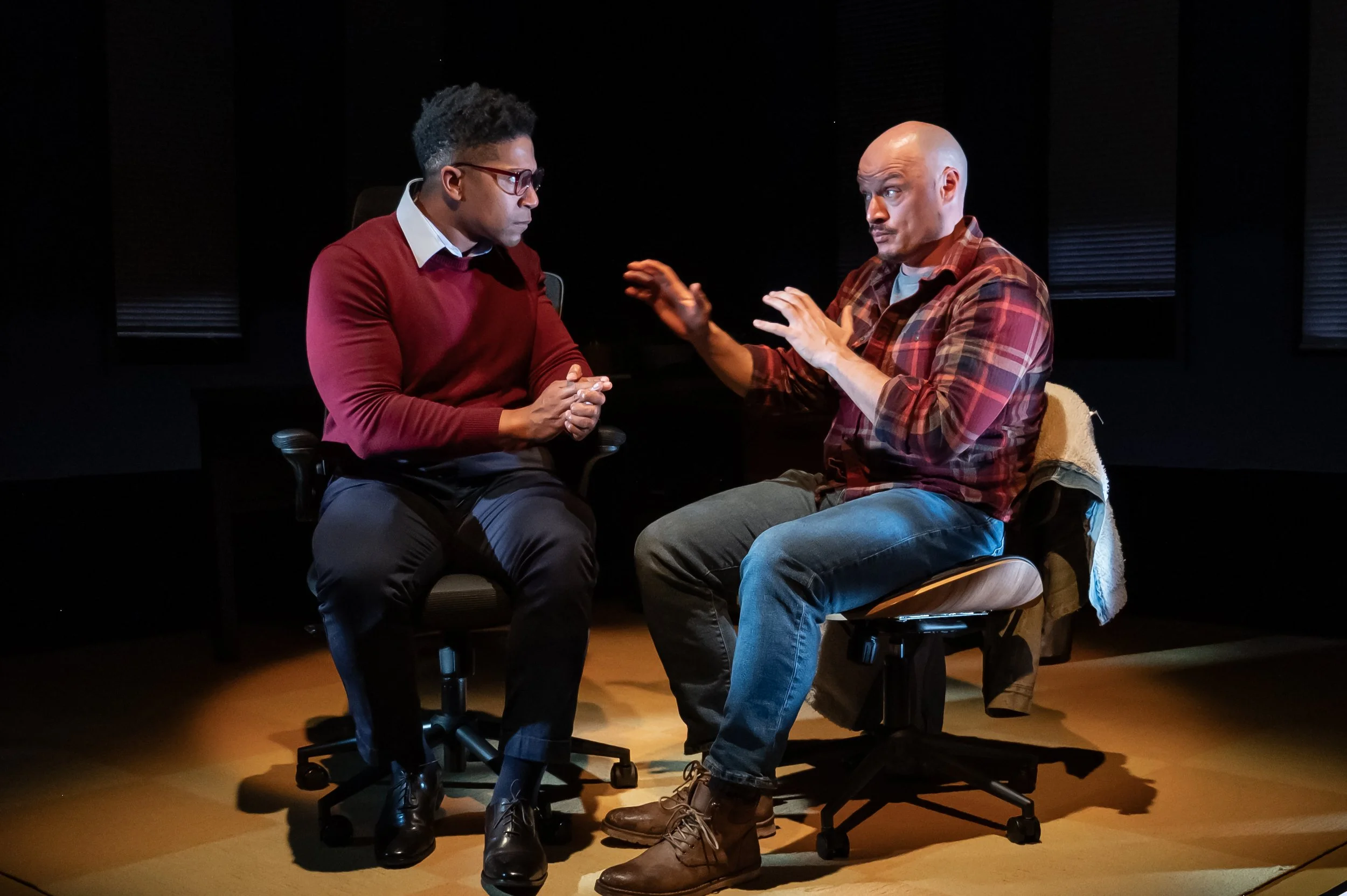
Jaysen Wright as Keith and Lee Osorio as Ryan in Mosaic Theater’s production of A Case for the Existence of God by Samuel D. Hunter. Directed by Danilo Gambini with Nadir Bey (scenic designer), Danielle Preston (costume designer), Colin K. Bills (lighting designer), Sarah O’Halloran (sound designer), and Pauline Lamb (properties designer). Credit: Chris Banks